Showing posts with label Movies. Show all posts

Sunday, November 13, 2016

The Canadian Church Connection to Mel Gibson's New Movie, Hacksaw Ridge


People who see Mel Gibson’s new movie, Hacksaw Ridge, might be surprised to learn that not only Mennonites were opposed to that war. They would be surprised to learn that the movie would never have been made if not for the dogged determination of a Canadian—my friend Stan Jensen.

When it comes to conscientious objection in Canada, Mennonites tend to get the most attention. 

With over 60% of the 10,700 men who did alternative service during the war coming from Mennonite churches, that's to be expected. 

But the ranks of those who did alternative service to being in the military during that war included Seventh Day Adventists, Jehovah’s Witnesses and Quakers—groups that also teach against participation in war—together with men from many other denominations.

Unlike those conscientious objectors who served at lumber camps, building roads, or working in mental health facilities, the hero of Hacksaw Ridge, Desmond Doss, chose a different route. He decided to join the military as a medic.

As he put it in an interview, he was not a conscientious objector but a “conscientious collaborator,” believing that America’s involvement in that war was right and just. He just refused to kill.

Shipped to the Pacific theatre, Doss saved the lives of 75 wounded comrades during the fierce and bloody battle of Okinawa, winning the Congressional Medal of Honour—America’s highest military medal for valour.

It’s an amazing tale of courage, both on the battlefield and in basic training. The movie is the story of how someone could stay true to his conscience, despite being scorned and bullied by the same soldiers whose lives he later saved.

But Doss’ story would never have become a major Hollywood movie if not for Stan Jensen, 63, Communications Director for the Seventh Day Adventist Church in Canada.

In 1974, Jensen read a book about Doss titled The Unlikeliest Hero, published in 1967. “I developed a passion to see it told more broadly,” he says.

In 1996, he left Canada and moved to Los Angeles to manage a bookstore. He hoped being closer to Hollywood would help him meet someone who could turn Doss’ story into a movie.

And that’s exactly what happened. During a special event at his store, one of the attendees was Gregory Crosby, a well-connected screenwriter in the movie industry.

At the time, Crosby was working on a TV series about Medal of Honour recipients.

“I told him, I have the perfect story for you,” says Jensen, who gave him a copy of The Unlikeliest Hero.

After reading it, Crosby was so moved by Doss’ story that agreed to try to make it into a Hollywood movie.

“I never really had the desire to produce anything until Stan Jensen brought me the amazing story,” he said in an interview. “I knew right away I wanted to be involved with the project from beginning to end.”

But before that could happen, they first needed to convince Doss—he didn’t go to movies, and didn’t like Hollywood.

“He was afraid that if they made a movie about his life, they’d change his character, Jensen says—that a movie would show him smoking, drinking and chasing women. “He didn’t want to risk that.”

When Jensen and Crosby assured him that wouldn’t happen, Doss gave his permission.

“You can just imagine how I felt that day,” Jensen says.

It took many more years of discussions and negotiations before Mel Gibson signed on as a director in 2014. The movie was released in November in Canada.

For Jensen, seeing Doss’ story on the big screen is the fulfillment of a dream that goes back over 40 years. He hopes many people will go see it and also be inspired—just as he was when he first encountered it so long ago.

“In this day, when the hero of so many movies is the person who kills the most people, Hacksaw Ridge shows that someone can be a hero by saving lives,” he says.

And what does he think Doss—who died in 2006—would think of Hacksaw Ridge?

“It’s truly a stellar movie,” he says. “I think he would be pleased with how his story has been told.”

From the Nov. 12, Winnipeg Free Press.


Friday, February 28, 2014

The Face of Christ: No Movie Star Good Looks?


Diogo Morgado as Jesus in Son of God.


The new movie Son of God is out. Like most other movies on this subject, Jesus is an impossibly handsome white man—the opposite of what the real Jesus likely looked like over 2,000 years ago.

In the most recent cinematic version, by the husband-and-wife team of Roma Downey and Mark Burnett of History Channel’s The Bible fame, Jesus is what a Toronto Star movie critic calls a “chill” messiah, with “great hair, a perfect pearly smile” and a “laid back bearing.”

It reminded me of a column I wrote back in 2009 about forensic research into what a typical Palestinian man in Jesus’ era might have looked like. Spoiler alert: He doesn’t look the Jesus in the movie Son of God.

When you think of Jesus, do you imagine him as a muscled biker, with the word “father” tattooed on his bulging bicep?

How about as a sweat-glistened boxer, leaning on the ropes after a successful fight?

Or maybe as a laughing bridegroom in a tuxedo, hugging a flower girl?

Those are some of the images that American artist Stephen Sawyer sees when he thinks of Jesus.  

Jesus the boxer.


Through his “Art for God” series, Sawyer wants to “reflect the life and teachings of Jesus in the 21st Century.”

Of course, nobody knows what Jesus looked liked. But we can be pretty sure he didn’t look like the Jesus in Sawyer’s paintings—a fair-skinned white Anglo-Saxon with an angular face, long, brown hair and movie star good looks.

Sawyer’s rendition of Jesus hearkens back to Warner Sallman’s Head of Christ, the famous picture of a handsome fair-skinned Jesus with the upturned gaze and long flowing hair.

Sallman's Head of Christ.


Created by Sallman in 1924, the rendition went on to become the best-known representation of Jesus throughout much of the last century, gracing many a North American living room.

When many people today think of Christ, it is that painting that comes to mind.

Both Sawyer and Sallman have it wrong—as do the makers of the new movie the Son of God.

In 2002, forensic scientists created a model of what Jesus could have looked like, based on ancient skulls from the region near Jerusalem where Jesus lived and preached.

Using specialized computer programs, they came up with a model of a typical Jewish man of Jesus’ era. For eye and hair colour, they used drawings found at various first-century archeological sites.

The result, which was broadcast on the 2001 BBC in a show titled The Son of God, was a man with a broad face, curly hair, a short beard and dark eyes—a typical middle eastern man, in other words.

And what Jesus might have
really looked like.


"It's not the face of Jesus, but how he is likely to have looked given the scientific information we've got," said Lorraine Heggessey of the BBC. "That's what people from that area of the world looked like at that time."

In fact, the image of Jesus has been a rather fluid thing over the centuries, reflecting the political, cultural and other realities and imaginings of various times and places.

He was been portrayed as emperor and ruler by the ancient Romans and Byzantines, and as a clown and counter-culture figure in the musicals Godspell and Jesus Christ Superstar.  

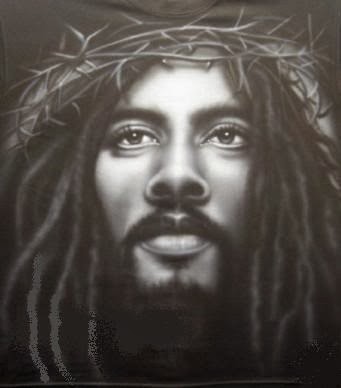
The Black Jesus.


African-Americans also have their own image of Jesus, and he's also been portrayed as a revolutionary or a liberator, freeing the oppressed. 

The Che Guevera Jesus.


“There is a Christ for every age," says Neil MacGregor art historian and director of the Great Britain’s National Gallery.

For series presenter Jeremy Bowen, the computer-generated image of Christ should look familiar to anyone who has travelled in Palestine or Israel.

 "He was a Middle Eastern Jew. If you go to Jerusalem today, a lot of people look like that."